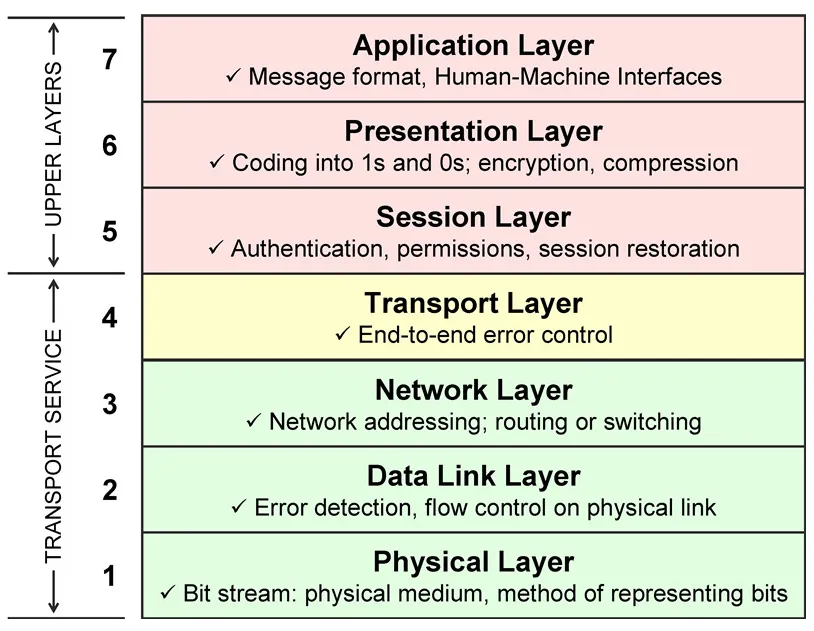
The Open Systems Interconnection (OSI) model is a reference stack: seven named layers that describe where framing, routing, reliability, and application protocols fit. Real systems blend layers (TCP/IP is the practical stack on Linux and everywhere else), but OSI vocabulary still shows up in interviews, vendor docs, and fault isolation.
Layer 1 and 2 — physical and data link
Physical is bits on the wire or radio. Data link frames packets on one hop—Ethernet MAC addresses and switches live here. VLAN tagging also sits at layer 2; see VLAN.
Layer 3 — network
Network handles addressing and routing across hops—IPv4, IPv6, and routers. Linux applies routing with the kernel FIB and tools such as ip route; concepts are in IP addressing and IP routing.
Layer 4 — transport
Transport adds end-to-end delivery semantics: TCP (reliable, ordered) and UDP (datagrams). Ports belong to this layer. Socket APIs expose transport to applications on Linux.
Layer 5 and 6 — session and presentation
Session and presentation (encryption encoding, serialization) are largely folded into modern application libraries and TLS. OSI still names them; day-to-day debugging rarely treats them as separate boxes.
Layer 7 — application
Application protocols include HTTP, FTP, DNS messages, and SSH user authentication. They run over TCP or UDP.
Using the model on Linux
When traffic fails, walk the stack: link up (ip link), address present (ip addr), route correct (ip route), port listening (ss -tlnp), then application logs. Host-specific pieces—predictable interface names, systemd-resolved, nftables—are covered in Networking on Linux, not repeated here.